Posts

Showing posts with the label paper-a-week

To GM or not to GM? Another look at the data...

A recently circulated paper by Vendomois et al takes an independent look at data from food trials of genetically modified (GM) corn on rats. The data was originally obtained in studies conducted by Monsanto as part of the application for market approval of these GMOs. I'd like to highlight a few points here. But first, some introduction. The original data stems from a trial where a population of rats was fed different kinds of GM corn over a period of 90 days. The GM crops in question were Monsanto's NK 603, MON 810 and MON 863. NK 603 is one of the Roundup Ready crops. Roundup Ready crops are genetically engineered to withstand large doses of Monsanto's herbicide Roundup. The idea is that fields can be sprayed with Roundup, the genetically engineered Roundup Ready crops survive, and all the weeds around it die. Let it be mentioned here that this approach has drawbacks all its own, as weeds have started to develop a resistance to Roundup over the years, which led to e...
Readings: "Steps toward broad-spectrum therapeutics: discovering virulence-associated genes present in diverse human pathogens"

Reading Stubben et al: " Steps toward broad-spectrum therapeutics: discovering virulence-associated genes present in diverse human pathogens" BMC Genomics, Volume 10, Issue 501, 2009 http://www.ncbi.nlm.nih.gov/pubmed/19874620 I found this paper interesting for several reasons: first, it follows a metagenomics approach, second it involves data mining work, and third, it's a step towards making an abstraction from individual pathogenics organisms to a more general understanding of virulence at a biomolecular level. In the abstract, the authors summarize the objective of their work: "New and improved antimicrobial countermeasures are urgently needed to counteract increased resistance to existing antimicrobial treatments and to combat currently untreatable or new emerging infectious diseases. We demonstrate that computational comparative genomics, together with experimental screening, can identify potential generic (i.e., conserved across multiple pathogen spec...

Paper-a-day

A few words on the posts labeled with "paper-a-day": Every day, I'll try to write about one paper I read that day. I mainly do this because writing about a paper helps me understand and remember its contents better. And maybe someone out on the interwebs gets something out of these summaries, too. P.S.: I renamed the category to "paper-a-week", for obvious reasons.

Readings: "Alternative trans-splicing: a novel mode of pre-mRNA processing" by Horiuchi et al

Image
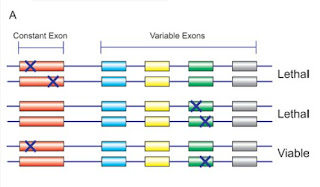
Reading Horiuchi et al: Alternative trans-splicing: a novel mode of pre-mRNA processing Biology of the Cell, Volume 98, Issue 2, 2006 http://www.ncbi.nlm.nih.gov/pubmed/16417469 Horiuchi's paper summarizes a number of findings concerning the subject of trans -splicing. Trans -splicing is a mechanism that naturally occurs in cells. It has also been experimentally used to correct genetic defects in mice, so it is both an interesting natural phenomenon and a possible avenue of investigation for therapeutic applications. Splicing, inside a cell, is one of the numerous steps from DNA to RNA to protein. Splicing operates on premature mRNA (pre-mRNA for short), from which it excises introns and joins the remaining exons back together. Splicing comes in two varieties: cis and trans . Cis -splicing joins exons within a single pre-mRNA molecule, while trans -splicing joins exons from different pre-mRNA molecules. Trans -splicing seems to be rare compared to cis -splicing, but it ...